
Events &
Training
Explore and register for our upcoming events below.

Gospel Coaching & Supervision

The Gospel Coach provides training and support for the relational, personal, missional and spiritual aspects of a leader’s life. Our qualified coaches are available to partner with those establishing a church plant and with those who already have an established ministry. Our support is provided online in 1-hour sessions, but we can set times and frequencies that work for your needs.
Tailored Support
We provide three types of support:
Gospel Coaching, monthly sessions with a matched coach. These may have a specific focus, such as church planting, NextGen ministries, evangelism or church vitality; and we have a range of non English language options.
Professional Supervision, commonly 4-6 times annually, by supervisors who meet denominational requirements.
Missional Impact Coaching, project based. Directed coaching to achieve a specific project, setting goals and timeframes and providing an accountability framework.
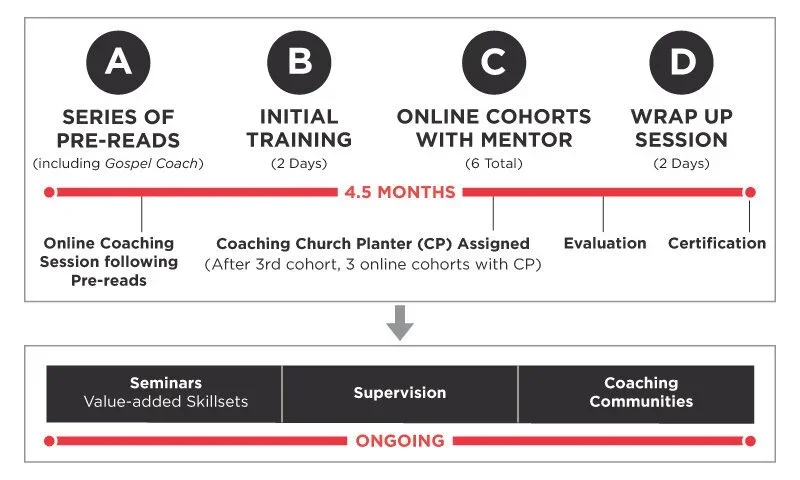
COACH TRAINING
Coaching provides church planters with support, assistance and accountability. A coach helps a planter develop their church planting competencies, addresses personal life issues, and provides insights into role navigation in the church planting project in the context of a friendship. It is a process of imparting encouragement and skills to the planter in order to succeed in starting a gospel-centered church, in the context of a gospel friendship.
Evangelism Training For The Everyday Christian

Many everyday Christians still feel nervous and uncertain about initiating or continuing conversations about faith with their friends. Despite their enthusiasm, there's a gap between desire and confidence.
Evangelism is the responsibility of the whole church. Therefore, developing and refining skills, and creating space for continual practice and encouragement is essential. We have a heart to equip everyday Christians with the confidence and evangelism skills they need to help their friends know Jesus.
City to City Australia offers three workshops to help you build these skills.
WORKSHOP 1: Explaining the Gospel to Your Friends What do you say when someone gives you the chance to explain Christianity? This workshop helps participants clearly and carefully explain the gospel message. It also explores likely questions and conversations that arise from such discussions, encouraging real-time practice and reflection.
WORKSHOP 2: The Conversational Spiral How do we move from everyday topics to deeper conversations about life, God, and faith? This session focuses on crafting and practicing natural, relational pathways that help connect daily conversations to spiritual ones. Participants will develop a toolkit of thoughtful, respectful, and engaging questions.
WORKSHOP 3: Explaining Tricky Biblical Words How do we communicate words that don’t translate easily into contemporary culture? This workshop identifies common Christian terms that are confusing or misunderstood outside the church. Together, we’ll explore more accessible alternatives and practice explaining key theological concepts in everyday language.
You can choose how to access these workshops.
COST
In-Person Training
Half-Day (All 3 Workshops): $600 (plus travel expenses, ex GST)
Single Workshop: $300 (plus travel expenses, ex GST)
Online (via Zoom)
Single Workshop: $300 (ex GST)

Learn Preaching From Keller

Join us for a special Advanced Incubator unit on Preaching, with the late Rev. Dr. Timothy Keller - the founder of Redeemer City to City ministries, and author of bestselling books “The Reason for God” and “Centre Church.”
One of the projects that Dr. Timothy Keller invested in for the last couple of years of his life was called the City Ministry Program, hosted in New York. He taught classes of church planters and pastors, each week making a pre-class video, and then leading the in-person seminar.
The City Ministry Program has now been contextualised for Australia as an Advanced Incubator unit titled Learn Preaching From Keller.
The Incubator will meet over 8 full-day, in-person sessions throughout the year in Sydney, and the material covers the following topic areas:
Preaching the Text of Scripture
Preaching Christ from all of Scripture
Preaching to the Heart
Preaching to Culture
Dates and Locations
The City to City Learn Preaching From Keller Incubator 2027 will be delivered in the following locations:
Melbourne (dates to follow)
Sydney (dates to follow)
Cost
AUD$1,200 per person

Incubator Core

Research has shown that an effective church leader or planter must be proficient in four critical competency domains:
Living inter-connectedly with a gospel dynamic (Personal—Interpersonal domain)
Communicating grace and truth in a way that forms and engages disciples (Prophetic domain)
Creating a missional culture (Priestly domain)
Executing visionary leadership (Kingly domain)
The Incubator training curriculum is designed to help church leaders and planters develop proficiency in each of these four domains (as determined by research which discovered the 34 church planter competencies upon which we build our program). Each training module is aimed specifically at addressing one or more of the 34 church leader or planter competencies.
The modules are divided into four units:
Unit 1: Gospel theology & spirituality
Unit 2: Gospel contextualisation & mission
Unit 3: Gospel communication & community
Unit 4: Gospel leadership & influence
The units are typically offered in sequence over two years in each city. You may join the Incubator at the beginning of any unit, and there is no need to complete the units in sequence.
Each Incubator learning module involves time for peer-to-peer coaching, personal spiritual formation, application of ideas to real-world problems and hands-on training that combines theology, church leadership theory and best practice in adult learning.
INCUBATOR CORE UNITS
-
Module 1: Gospel Theology
This module focuses on understanding how the work of Jesus Christ changes everything we are and do—as individuals, as a community, and as ministers of God’s grace—as opposed to “just trying harder” to apply biblical principles to my life. We know the gospel is the life-giving message of redemption that we always preach. And many of us are convinced it is also the dynamic that causes on-going transformation in our lives and communities. This unit will help you more consistently apply this in your life and leadership.COMPETENCY OUTCOMES:
• Exhibits a grasp of the gospel of grace as a ‘dynamic’ in life, not just having sins forgiven.
• Can articulate the broad scope of the gospel as it relates to life and ministry
• Able to describe the “two thieves of the gospel” and which he/she tends toward
• Can describe the difference between “the gospel” and a moralism or self-esteem approach to personal growth
• Grasps how the gospel affects the ‘what’, as well as the ‘how’ of doing ministry
Module 2: Personal Grace Renewal Dynamics
It’s not enough just to understand the gospel; we need to be constantly experiencing the renewing work of Jesus Christ, making us new and sending us as his people in his redemptive mission. This module helps participants experience gospel renewal through sharing, case studies, guided prayer and learning activities centred around the basic truths of our adoption and the reality of indwelling sin (idolatry).COMPETENCY OUTCOMES:
• Continues to grow in personal transparency as well as gospel renewal in his own life
• Able to explain the role of idols and can identify his/her own tendency toward idolatry
• Practices a lifestyle of repentance and faith, growing confidence and joy in Christ
• Is able to lead others into a discovery of both their idolatry and what gospel repentance looks like
• Also understands how to use the CLI to develop personal learning motivation and objectives.
Module 3: Personal Life of the Gospel Centred Leader
Though we endeavour to care for the church leader’s personal life every time we meet, this module gives the topic special treatment. The effective leader knows how to do self-leadership and self-care before he or she leads others. This module focuses on the character of the leader as well as understanding your unique leadership style so you can manage yourself and others in order to more effectively engage in the work of the kingdom of Christ.COMPETENCY OUTCOMES:
• Exhibits a bias toward action, consistently executing evangelistic, cultural and ministry plans.
• Constantly assesses the environment, sees needs, learns from failure, and gets the new information, skill set, resource or personnel that the job requires. (Though ‘learning agility’ cannot be trained into a person, we can encourage the development of some skills that help the planter to be a more agile learner)
• Knows the unique temptations of a leader and embodies a servant-model of leadership that encompasses the role of suffering, spiritual conflict, authority, humility and love in the leader’s life (Gospel-based leadership)
Module 4: Kingdom Centred Prayer
The heart of the ministry of Christ’s kingdom is expressed in prayer. Since the Holy Spirit is the indispensable agent of any true ministry, the church is called to express its life, and do its work, through the agency of prayer. Through prayer the gospel renews us, we learn more deeply of God’s priorities and we receive new empowerment for what he is sending us to do.These kingdom concerns are reflected in the model prayer of Jesus. This module trains church leaders in kingdom prayer by practicing it.
COMPETENCY OUTCOMES:
• Exhibits a passionate prayer life, both personally and corporately and trains others in kingdom prayer
• In his/her leadership, knows how to bring prayer to bear on strategic ministry initiatives
• Can develop a workable Action Plan that is realistic, comprehensive, and contextualised -
Module 5: Gospel Contextualisation
This module focuses on understanding the unique globalised, urban context in which we live and how that understanding can help us communicate and develop ministry forms which are meaningful to the people we are reaching. Far from ‘capitulating’ to culture or ‘watering down’ the gospel, contextualisation aims to make Christ alive and dynamic in the given situation where you are planting your church.COMPETENCY OUTCOMES:
• Has a positive view of culture and is eager to engage, and train others to engage, with the ideas and people who form culture
• Can employ ethnographic research skills and data to discern the values and key understandings of a given people and to determine the needs which the ministry of the church should address
• Can contextualise ministry forms (preaching, spiritual formation programs) and approaches (POM, evangelism, mercy ministry) in such a way that Christ comes alive in that culture
• Given an issue, is able to ‘do theology’ in such a way that allows God’s word to speak to a specific culture
• Is growing personally as a ‘contextualiser’ of the gospel (being challenged by his/her own cultural bias and growing in love and understanding of his/her context, thus applying the gospel to it in new ways)
Module 6: Evangelistic Networking
This module aims to help learners develop the skill of consistently and winsomely presenting Christ to others in a host of new situations, so that communicating Christ becomes an integral part of the culture of the new church. Emphasis is placed on developing “evangelistic pathways” and networks of relationships which grow out of a culture of hospitality in the church as well as how to think about evangelistic events, process evangelism and the training of others in your church.COMPETENCY OUTCOMES:
• Experiences increasing wonder in the all-sufficiency of the gospel for every need
• Exhibits consistency, creativity and winsomeness in regular, personal evangelism
• Knows how to ‘network’ evangelistically and use relational pathways
• Is able to engage the church in evangelistic endeavours (relationships, events, etc.) so that the church develops a missional culture
Module 7: Missional Ecclesiology
There is a lot of talk today about “being missional”. Practically, what does that mean for a church? This module helps participants understand the unique characteristics of ministry in the global city and helps them develop a balanced, missional culture in their church so that the good news of Jesus is expressed in every element of church life and reaches out in holistic ministry.COMPETENCY OUTCOMES:
• Has a theologically driven vision for the church and city. (Church Planting Movements and a redemptive/historical theology of the city)
• Develops a strategic model (Philosophy of Ministry) of the church with ‘outward-faced’ and ‘balanced’ ministries
Module 8: Mobilising Others in Mission
The effective church leader knows they cannot grow a church by themselves. Instead, they become leaders and pastors of gifted Christians who do the work of ministry. Thus it is important for church planters to know how to assess people’s strengths and weaknesses and how to develop systems of relational training and oversight that guide people to their place of most effective ministry.COMPETENCY OUTCOMES:
• Is able to read people, knowing their strengths, weaknesses, alignment to the vision, openness and loyalty
• Is able to design and implement an effective leadership training program that is gospel-based, relational, transformational, etc and provides the church with the leaders that it needs
• Knows how to recruit the right people and direct them effectively so that they are growing in their personal lives and productive in ministry -
Module 9: Proclaiming Christ from all of Scripture
This hands-on preaching practicum aids participants in finding Christ in every text of Scripture and in developing the confidence that beholding Christ in the gospel is what transforms us. Participants analyse model sermons, as well as their own, and practice constructing gospel-based sermons that make Christ the resolution of the problems which affect our urban, and many times, skeptical listeners.COMPETENCY OUTCOMES:
• Has a gospel understanding of the Scripture and can preach about many issues from many texts by showing Christ and not resorting to moralism, shaming, or passive antinomianism (theological content)
• Is able to bring people face to face with Christ. In confronting, comforting, encouraging, or challenging, the gospel is always the dynamic in how people change (how people change)
• Makes the gospel ‘fascinating’ with context-sensitive passion, argument, transparency, scholarship and application (sermon construction)
Module 10: Applying Christ to the Heart by Grace
This module is a hands-on practicum that helps learners develop the skill of “applying Christ” to listeners’ hearts and minds so that they change in a biblical way, instead of through resorting to moralistic or ‘feel-good’ applications of Scripture. Issues such as “growth in communication skills”, “finding your voice”, “how to study” and other practical matters of homiletics are addressed.COMPETENCY OUTCOMES:
• Able to explain the difference between preaching from a moralistic paradigm and a biblical one
• Is able to bring people face to face with Christ. In confronting, comforting, encouraging, or challenging, the gospel is always the dynamic in how people change
• Is a competent, engaging communicator. You are easy to listen to and you engage with an audience (mechanics of speaking)
Module 11: Dealing with Conflict in the Grace of Christ
In this module, church leaders practice how to understand the conflict and differences of perspective that so commonly disrupt the life of congregations and how to bring truthful and powerful communication skills to the people they work with. Time is given to practicing how to have a gracious and wise “difficult conversation” with a person with whom you need to interact.COMPETENCY OUTCOMES:
• Graciously engages in conflict resolution and church discipline without avoidance or blame shifting and teaches others to do the same
• Able to develop a culture of gracious conflict resolution in the church and community that trains people how to engage the pain and wrong in personal and community areas and bring shalom
Module 12: The Grace Dynamics of Corporate Renewal
Every few years we recognise our need for renewal: physically, emotionally, relationally and spiritually. But we need more than personal renewal. Churches need renewal as well. This module equips participants in the continuous spiritual renewal of their congregation by understanding the theology and relational dynamics of renewal, as well as the practical ministry issues involved in effectively planning for and bringing renewal into the life of the congregation.COMPETENCY OUTCOMES:
• Able to explain how the gospel fuels individual and corporate renewal
• Values living in honesty and transparency, makes choices that reveal his/her knowledge of his/her deep need for others in worship, personal change, ‘re-creative’ fun and effective ministry to the world
• Is able to develop and lead efforts/plans/programs that lead the church into renewal -
Module 13: Executing Visionary Leadership
In order to see people engaged, transformed, equipped and empowered, leaders need vision but they also need to chart a path for people to follow, giving attention to execution as well as ministry design. Keeping spiritual formation at the forefront of this, leaders will gain clarity about how they need to grow in communicating ministry vision, establishing appropriate measures to monitor progress, and develop their self-awareness about and plan for growing in the spiritual maturity required to lead with humble confidence.COMPETENCY OUTCOMES:
• Communicates ministry vision in a way that inspires others to act
• Identifies and establishes appropriate measures to monitor progress towards Kingdom vision
• Identifies relevant areas of strength and development to foster growing spiritual maturity and self-awareness
• Articulates coherent and contextual ministry strategy using a plan on a page or infographicModule 14: Leadership Through Others
From working directly with teams to empowering others to build and work in their own teams, ministry leaders need to learn to lead through others — especially as their ministries scale or multiply. To do this they must grow in understanding the various levels of leadership, designing development plans to raise up leaders relevant to the context (ideally in the context of an established learning community or pipeline), and gain and practice skills in giving feedback around performance with a developmental orientation.COMPETENCY OUTCOMES:
• Identify the relevant gifts and capabilities required for people to play their part in achieving the ministry’s kingdom vision and strategy
• Identify potential men and women to raise up as leaders, who undergo regular capability reviews so their development needs are clear
• Develop a bespoke leadership framework for your ministry context that provides a clear and accessible pathway for discerning the gifts, skills and talents congregation members and seeing them develop
• Distinguish between pastoral and performance issues with staff members and volunteers in order to provide effective feedback that helps them developModule 15: Leading Ministry Transformation
This module addresses the challenge of implementing a ministry approach that makes change and transformation a priority — from the personal level upwards. As well as developing a toolkit to assist personal transformation through repentance, reflection and learning, participants will practice skills in goal-oriented and gospel-saturated coaching to disciple others towards spiritual maturity and effectively implement lasting change.COMPETENCY OUTCOMES:
• Embraces and advocates rhythms, habits and practices that enable personal change and growth through repentance, reflection and learning
• Uses goal-oriented gospel coaching to walk alongside others as they mature in Christ and develop as leaders
• Prepares a change management plan for an area of ministry that needs development to effectively implement lasting change
• Able to speak and listen with love and radical candour, differentiating between the needs of different kinds of stakeholders
• Develops a personal action plan to address gaps and growth areas in their leadership
Module 16: Leading for the City
Christian leadership must take us well beyond the four walls of a church and the Christian community into the cities and contexts of which we are part, to seek their good and wellbeing. In order to do this, leaders will need to embrace and grow in build deep, trusting relationships with other church leaders (outside their own church, network or tribe), developing and articulating a vision for whole of life discipleship — integrating faith and work, mercy and justice, words and deeds — and find sustainable rhythms for identifying resources and catalysts for gospel movement in the city.COMPETENCY OUTCOMES:
• Able to articulate and implement strategies to develop leaders beyond the church, expressed in an action plan to amplify emerging leaders outside the church context
• Confident to identify resources and catalysts to develop unity efforts, kingdom collaboration and gospel movement in a city/area
• Develop sustainable practices of self-leadership to ensure long terms health that balances personal and public as well as church-focused and city-focused aspects of movement leadership
• Map relevant stakeholders and construct a plan to develop a gospel movement focused on serving, blessing and seeking the flourishing of the city/area
Dates and Locations
The City to City Incubator Core 2027 will be delivered in the following locations:
Melbourne (dates to follow)
Cost
AUD$1,100 per person, per year (2 units per year)

How To Run An Evangelistic Course

Are people becoming Christians in your church? Do you know how to run an evangelistic course? Are your current efforts yielding fruit, or do your leaders feel underprepared?
Some churches are offering evangelistic courses but not seeing results due to gaps in understanding or execution. Others are yet to begin. This training offers a practical and inspiring pathway - helping leaders create a welcoming, thoughtful, and gospel-rich environment where people can genuinely explore faith and respond to Jesus. It will equip a church to invite non-Christians to a course, offering warmth, welcome, good interaction with gospel explanations, thereby giving them the opportunity to become Christians.
Mock Session (In-Person)
This interactive session demonstrates how to run an evangelistic course, covering:
Advertising strategies that work
Course setup and hospitality
Creating a warm and engaging welcome
Asking good questions and using them to uncover spiritual concerns
Choosing the right course for your context
Building a church culture that supports evangelism
Clarifying the role and strengths of course-based evangelism
Weighing the pros and cons of different approaches
Training leaders and team members effectively
COST
Total Training Package: AUD$375 (ex GST) includes:
1-hour online preparation session (to help set up logistics and vision)
2-hour mock session with a meal (practical walkthrough)
1-hour follow-up review session (reflect, debrief, and refine)
Note: Standard travel costs apply per state for in-person delivery.

God Is Setting His Table In Your City

God is inviting His spiritual leaders of cities to come to His table of oneness, that is centred on Him, focused on their city. There is a shout from Heaven around the globe, calling every denomination, every church leader, to start the journey of reforming the church, bringing “my” church into the fullness of the “we” church for the city. It’s in response to the prayer of Jesus in John 17, we are being called to be reshaped so we are fit for the purpose of discipling our cities, as we are called to do in Matthew 28. There are over 80 cities across the country that God has commenced this journey in.
We want to invite you to the table as we share stories together, learn and encourage each other as we cast this vision of Oneness for our cities and to discern together what God is doing with the tables and cities that God has placed us.
This day is facilitated by Greig Whittaker (City to City Australia, author of Unity for Movement), Ian Shelton (One Heart Australia, author of God Is A City Builder), and Peter McHugh, (author of Radically Restored).
DATES & VENUES
Wednesday, 14 October | MELBOURNE
Eva Burrows College, 100 Maidstone Street, Ringwood
(For those who would like to stay for dinner, we will meet at 5:30pm where we will purchase our own meals.)
Tuesday, 20 October | SYDNEY
Wesley Mission HQ, 220 Pitt St
(For those who would like to stay for dinner, we will meet at 5:30pm where we will purchase our own meals.)
Time: 9:30 AM - 4 PM
Cost: $40 (Pay through bank transfer or PayPal below)

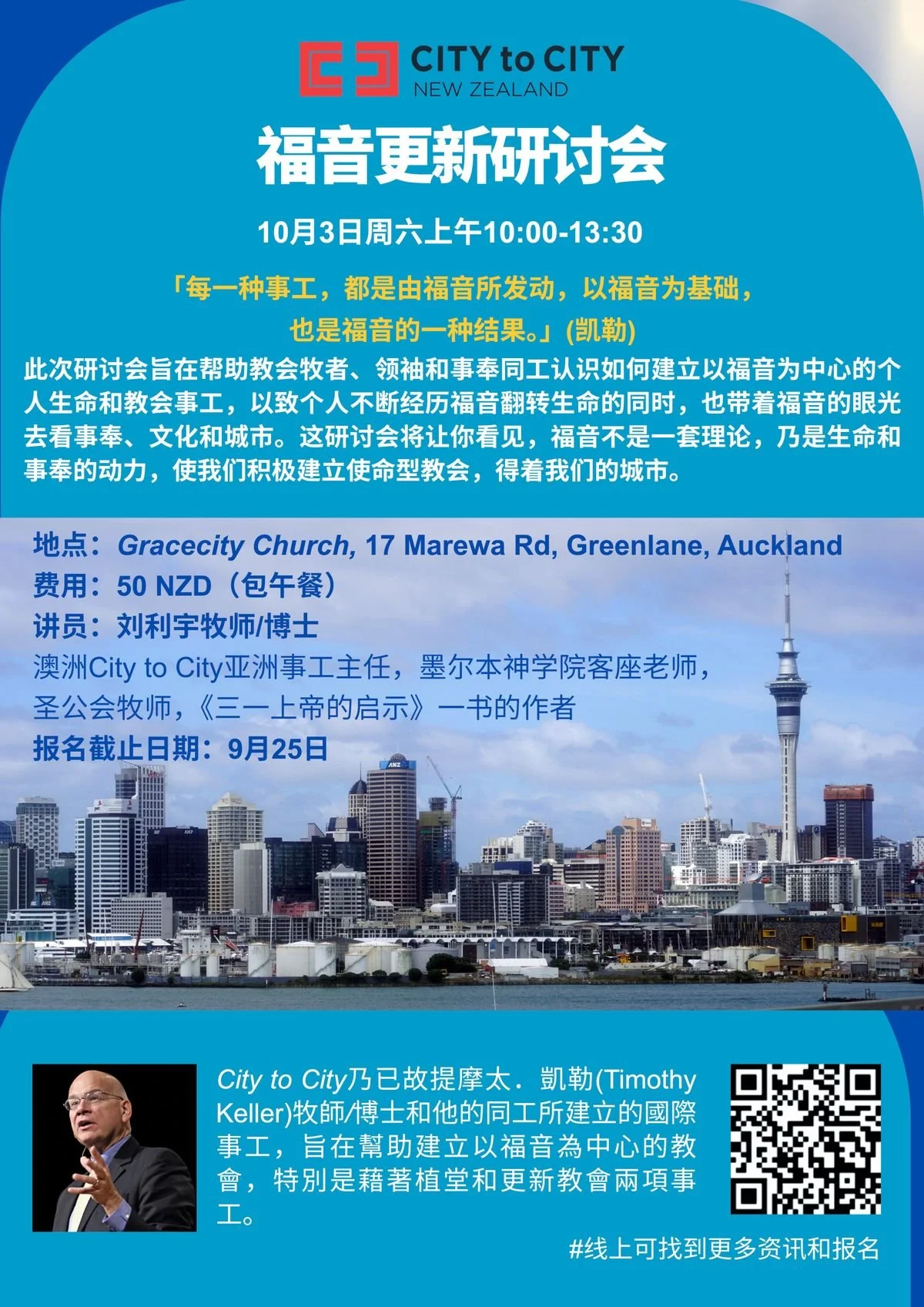
《奥克兰福音更新研讨会》
今天的福音派教会不是没有基督的福音,乃是没有将福音应用在基督徒生活的方方面面,以致福音的大能被限制了,没有完全被发挥出来。这即是凯勒与其他纽约的同工所建立的国际City to City机构的创办原因。他们的异象就是想祝福纽约,以及世界各地各乡各城里的教会,帮助他们打造以福音为中心的教会,也是使命型、多结果子和倍增的教会。
对City to City机构来说,教会要被翻转更新,首先是牧者领袖需要先被转化更新。这更新包括对福音的本质有更深一层的认识和体验,并且能够在圣灵的帮助下过一个认罪悔改和坚信福音的生命。这也是耶稣一出来所传讲的神国信息:「日期满了,上帝的国近了。你们要悔改,信福音!」(可一15)在这消极(悔改)和积极(信福音)的行动中,一方面,我们需要处理个人内心的偶像之问题,另一方面,我们要重申自己已获得「神儿子的名份」。这在基督里的新身份,最终必会带来新的眼光和新的价值观,我们的教会事工也因此被更新转化。我们开始从福音为中心的角度来看事奉,不再是个人的梦想或理想,乃是上帝对整个文化、城市和世界的心意。
因此,此次举办的研讨会目的,即是为帮助教会牧者、领袖和事奉同工认识如何建立以福音为中心的个人生命和教会事工,以致个人不断经历福音翻转生命的大能,不只带来属灵生命的突破,更带着福音的眼光来看事奉、文化和城市。最终,我们盼望看到一个福音运动的产生。
在此,我们诚心邀请您抽出宝贵的时间来参加这个研讨会,让我们一起来寻求神的面,并察验祂的心意,我们可以如何建立充满生命力和不断繁殖的教会,最终更得着我们的文化和城市。
你愿意与奥克兰的其他教牧同工一同来推动一个以福音为中心的运动吗?
讲座日期:2026年10月3日周六白天10:00-13:30
讲座地点:Gracecity Church, 17 Marewa Rd, Greenlane, Auckland.
费用:50 NZD(包午餐)
报名截止日期:2026年9月25日

When Your Kids Aren't Christian

This is a webinar for anyone in churches, who feel the weight of their kids not being Christians. It's a chance to pray together, to work out some ways forward and to have a chance to talk to others.
The webinar will be led by Julie-anne Laird, City to City Australia's Director of Missional Engagement.
Date: Monday, 24th August 2026
Time: 7pm to 8.30pm (AEST)
Location: On Zoom